

Maní, Yucatán: Where Memory, Bees, and Living Maya Culture Endure
Tucked into the southern Yucatán Peninsula, about an hour and a half from Mérida, the small town of Maní doesn’t announce itself loudly. There are no beach clubs, no all-inclusive resorts, no crowds funneling through on tour buses. What Maní offers instead is something quieter and far rarer: a place where Maya history is not just remembered, but lived—sometimes painfully, sometimes beautifully, always honestly.
Recognized as a Pueblo Mágico, Maní is best explored slowly. Walk its streets, sit in its plaza, listen more than you speak. This is a town where food, faith, and nature are deeply intertwined, and where the past still shapes the present in visible ways.
The Convent of San Miguel Arcángel: Faith, Power, and the Burning of Knowledge
The heart of Maní is the Ex-Convent of San Miguel Arcángel, a massive 16th-century Franciscan complex that dominates the town both physically and symbolically. Built atop a former Maya ceremonial site, the convent is stark, imposing, and impossible to ignore.
In 1562, Maní became the setting for one of the most devastating cultural losses in the Americas. Under the orders of Fray Diego de Landa, Spanish friars carried out an inquisition against the local Maya population. Accused of idol worship, Maya leaders were tortured, and sacred objects—including Maya codices, ceremonial items, and carved wooden idols—were gathered and burned in the town plaza.
These codices were not simple books. They were repositories of astronomical knowledge, history, religion, mathematics, and genealogy—centuries of accumulated understanding written in bark-paper manuscripts. Only four Maya codices are known to survive today. The rest were lost here, in Maní, in a fire meant to erase belief systems the Spanish did not understand.
Standing inside the cool stone walls of the convent today, the atmosphere is contemplative. The church is still active, still a place of worship, but it also carries an undeniable weight. Local guides and historians speak openly about what happened here—not to assign modern blame, but to acknowledge truth. This honesty is part of what makes Maní different. The story is not hidden.
For visitors, the experience can be sobering, but it is also grounding. To understand Maní is to understand that beauty and trauma can coexist in the same space.

Melipona Bees: Sacred Guardians of the Maya World
Beyond its historical scars, Maní is also a place of remarkable continuity—especially when it comes to the melipona bee (Melipona beecheii), a stingless bee native to the Yucatán and sacred to the Maya for centuries.
Known as xunán kab (“royal lady bee”), melipona bees were traditionally kept in hollowed logs called jobones. Their honey was never mass-produced; it was medicine, ritual offering, and spiritual symbol. Used to treat eye infections, wounds, respiratory issues, and digestive ailments, melipona honey was considered a gift from the gods.
Today, these bees are endangered due to deforestation, pesticides, and competition from European honeybees. In Maní, however, small-scale meliponiculture survives, passed down through families and revitalized by local conservation efforts.
Visiting a melipona sanctuary or family-run apiary in or near Maní is one of the most meaningful experiences the town offers. The honey itself is different—thinner, tangier, and more complex than commercial honey. But more than taste, what stays with you is the reverence. These bees are not treated as livestock. They are treated as relatives.
In Maya cosmology, bees are messengers between worlds. Protecting them is not just environmental—it is cultural preservation.

Food, Land, and Living Tradition
Maní is also quietly one of Yucatán’s culinary towns. Its cuisine is rooted in the milpa system—corn, beans, squash, chile, and native herbs grown together in sustainable cycles. Dishes here are not “reinvented” for tourists; they are cooked the way they’ve been cooked for generations.
You’ll find handmade tortillas, pib-style dishes slow-cooked underground, and flavors that rely more on technique and time than on spectacle. Food in Maní is not performance—it’s memory.
Why Maní Matters
Maní is not a destination for checklist travelers. It’s for those willing to sit with complexity—to admire a beautiful church while acknowledging what was lost there, to taste honey while learning why its source is sacred, to visit a town that does not exist for visitors but welcomes them respectfully.
In Maní, the Maya past is not romanticized or erased. It is present. And for those who take the time to listen, it speaks clearly. Maní is also organized and set up for tourism more so than some other nearby towns. So, take advantage that so much work has gone into presenting the past and present so well.
Visitor’s Guide to Maní, Yucatán
How to Get There
Maní is located about 90 kilometers (56 miles) south of Mérida and roughly 1 hour 30 minutes by car, depending on traffic. Driving is the easiest option; roads are paved and well-marked. Many visitors combine Maní with nearby towns like Oxkutzcab or Tekax for a full-day or overnight trip.
Public transportation is possible via regional buses or colectivos from Mérida, though schedules can be limited and complexity of figuring out routes and waiting times is not worth trying to cover this area by local public transportation. Renting a car is almost a must in this area. Plus, it leaves you open to stopping along the way at small lookout point, green houses, shops, and fruit stands.
Best Time to Visit
The best months to visit Maní are November through March, when temperatures are cooler and humidity is lower. April and May can be very hot, and there can be weeks or even months with little rain. This area of the Yucatan is the fruit basket of the peninsula. You will see many orchards of citrus and other fruit. So, it tends to look more picturesque when it is green. Summer brings higher humidity and rain—though the countryside is lush and green.
Try to visit in the early morning or late afternoon, especially if you plan to walk the town or explore the convent grounds.
What to See and Do
- Ex-Convent of San Miguel Arcángel: Visit respectfully and take time to read about its history. Guided explanations add important context. Saturday and Sundays there are timed tours of the Convent. During the week you can ask in the church office to see if a guide is available. Guides work on a tipping basis.
- Melipona Bee Sanctuaries: Arrange visits through local guides or community projects. These are educational experiences, not commercial attractions. You can find many listed on google maps. There is Meliponario “U Naajil Yuum K’iin” on the edge of town. You can visit here daily from 9am-5pm. Here you will find the owner who will show you the melipona bees and their hives. Explanations are given and there is a good selection of products made from the special honey. A tour is by tips. Tours are in Spanish.
- Town Plaza: A great place to observe daily life, especially in the evenings when families gather. Mani has done a nice job keeping the center attractive with parks and gardens.
- Museum of Embroidery. This small museum is just next to the main church. Entrance is free and you get to see beautiful examples of traditional embroidered Maya dresses. Some of which take months to make.
-
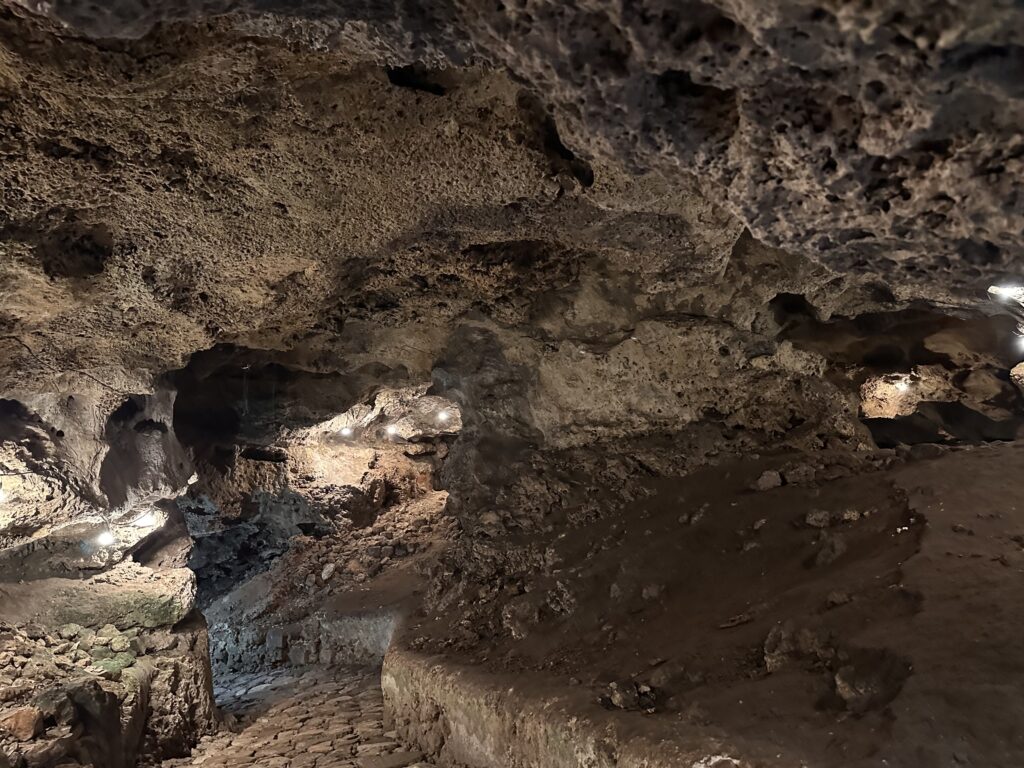
Cenote XCabachen de Mani. This is a small cenote in the middle of town. It is free to enter. There are stone steps down into the cenote and a small trail to an even small body of water. The cenote itself is only about the size of a parking spot, but going in gives you some fresh air and a look back in history where you can imagine locals coming to get water in the past.

The entrance to the cenote in town. - Local Kitchens and Cocinas: Seek out small, family-run eateries serving traditional Yucatecan dishes. for a small town, Mani does have several tourist restaurants. Look for poc chuc, a dish that was invented in Mani. It is a grilled pork served with condiments and tortillas to make tacos. In fact, there are many local dishes that you will not find in other parts of the Yucatan Peninsula, like the Riviera Maya.
Where to Eat
Maní is known for deeply traditional Maya-Yucatecan cuisine. Meals are often cooked slowly and served simply. Arrive early for lunch, as many places close by mid-afternoon. Lunch is the main meal in this area. Places that offer breakfast and dinner are often simple places with small menus. The top restaurants in Mani are:
- El Príncipe Tutul Xiu
- Cocina Tradicional de Maní
- Restaurante La Conquista

Where to Stay
Most visitors come for the day, but there are a few small guesthouses and boutique accommodations in and around Maní. Staying overnight allows you to experience the town after day-trippers leave, when it becomes especially quiet and reflective. There are about two types of accommodation in the area, budget hotels and high-end hacienda stay. You can make a budget trip or go for a hacienda (a ranch house estate that offers a large property and colonial architecture. Budget hotels can start around $35 USD and some haciendas can run you about $200 USD a night.
Tip: Since this area has many small towns and attractions are spread out, planning your visit to the area can be good if you find a good place to stay and use it as a base to explore the surrounding area.
Cultural Etiquette Tips
- Dress modestly, especially when entering the church or visiting rural homes. Most locals take off their hat when entering the church. There are no strict dress codes for the church, but being modest never offended anyone. Short shorts, crop tops and athletic bra tops can draw some attention.
- Always ask before taking photos of people, religious spaces, or private property. Some locals do not take a lot of photos while others are used to tourists visiting and they love showing off their culture and town.
- Be patient and unhurried—Maní moves at a slower pace, and that’s part of its charm.
- When visiting melipona sites, follow instructions carefully; these bees are sacred and fragile. Refrain from using repellants and other strong scents.
What to Bring
- Cash (ATMs are limited). the acceptance of credit cards is also limited in this part of Mexico. Mexico is a cash-based society. Bring small bills (20’s, 50’s, 100’s, and 200 peso notes. 500 bills can be hard to get change for.
- Sun protection and water. The sun is powerful year-round and there is high UV.
- Comfortable walking shoes
- A curious mind and respectful attitude
Why Go Slowly
Maní is not a place to rush through. Its stories—both painful and beautiful—deserve time. Whether you’re learning about the burning of the codices, watching melipona bees move quietly through their hives, or sharing a meal made from the surrounding land, the reward comes from slowing down and paying attention.
While you are in the Mani area, you might want to check out these places:
- Uxmal Ruins
- Choco Story Chocolate Museum
- Ticul and the ceramics made there.
- Orange Fair that is held nearby on Oxkutzcab where everything is built out of locally grown citrus fruit.
- Lol Tun Caves

About The Author

We stumbled upon Mani while driving around the Yucatan. We liked how clean it was and you could tell that a lot had gone into making the town feel charming.
The south of the Yucatan is full of hidden gems and very few tourists pass by these places. In a way it helps them keep so independent and authentic. Thank you