

Coba Ruins and Everything About Visiting
Coba ruins are an amazing experience within reach of Playa Del Carmen for a day trip (approx. 1hr 30 min. each way). What makes Coba ruins so interesting is the fact that it is in the jungle and the ruins are spread out with connecting trails. You can see how over time the trees and vines took over the city, and it was not until the 1920’s when archeologist from the outside world started to uncover this ancient city. Tourism did not start until the late 1970’s, and it was not until the 1990’s the site began to gain more rapidly on the tourist radar.
Today the area is magical with lakes with crocodiles, birds, nature and ruins that evoke a spirit of going on an adventure. The small village that now is outside the archeological site is a Mayan community. You can see the influences of the past with traditional Mayan houses. It is still today a less visited site then Tulum or Chichen Itza, so chances are you are going to have less people and more ruins to see (for example there are 3,287 people a day that visit Tulum ruins compared to 1,016 people a day that visit Coba ruins).
Our video guide to visiting Coba ruins
History of Coba Ruins
Here is a little history about Coba ruins. There are lakes in this area (which are rare in the peninsula) attracted Maya settlers from earliest times but a strong population growth in the area did not occur until around 100 AD. Between 200 AD and 600 AD, Coba controlled a vast area, including the north of the state of Quintana Roo and areas in the east of the state of Yucatan.

After 600 AD, the emergence of powerful city states of the Puuc culture and the emergence of Chichén Itza challenged the control of Coba, which had more closer ties, both cultural and economic, with the more southern Mayan centers of the Petén (what is now as Guatemala and the border with Mexico).
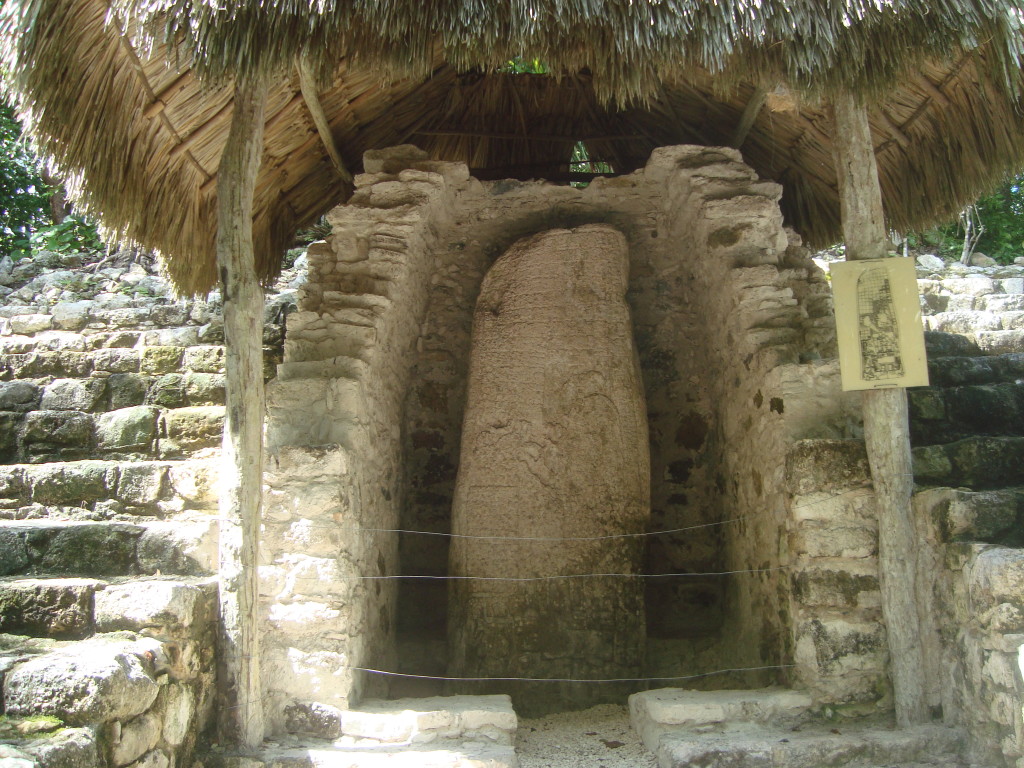
The stelae of Coba ruins that hold the hidden history
Unfortunately, the stelae (carved stone tablets) at Coba ruins today are in poor condition. Not as much is known about Coba’s history as other Mayan cities in the south. Archaeological evidence however indicates that by the 8th century it had as many as 50,000 people. Coba was also the hub of a system of roads called sacbes constructed by the Maya for commerce and general foot travel. Some of these roads can still be found in parts of the Yucatan and real adventurous persons today will explore these ancient trails.
Coba’s downfall came with the rise of Chichen Itza and the long war between the two cities. In 860 AD Yaxunáh was destroyed by Chichen followed by the defeat of Coba itself. The decline of Coba preceded the main collapse of all the Mayan cities in the region. The city was to revive a little when new temples were built and were used perhaps up until the 14th Century.
Today this site provides a good experience of seeing ancient temples and learning about the Mayan culture. It is recommended to get there early to beat the crowds and heat.

Coba Village Just Outside the Ruins
Before you get to the ruins you will pass through a small community. This is a more traditional Maya community, and you will see many thatched roof houses. The town is small and not too much to see as far as tourism goes.
You can spend the night in one of the few hotels in the Coba. There is not much to do but that is part of the charm, it is very quiet at night, and you can watch the sunrise on the lake in town and try to see some crocodiles.
Eating and Restaurants in Coba
After you visit the park, you might be hungry. There are several small restaurants in Coba village, but you will have more of a selection if you go toward Tulum. There are three small towns you pass through and there are small restaurants along this road.
One restaurant we recommend in Coba is Corcodilos. It is right across from the lake about halfway between the ruins and the turn in the road to Coba. There is a large tree in front of the restaurant. The reason we recommend this restaurant is the fact they have local food, handmade tortillas, and refreshing drinks all with local prices. Plus, they are smaller and don’t get large bus groups.
How much are Coba Ruins entrance price?
Pay parking is available for the site. It was 80 pesos the last time we were there. When you enter the parking lot you pay 120 pesos per person for access to the site. Then at the ruins entrance you pay another 100 pesos. these different fees go to different entities. So, the total price per person is 220 pesos. Entrance is free on Sundays for residents with ID and nationals.
When are Coba ruins open?
Coba ruins are open every day of the week from 8:00am-5:00pm. You do have to enter before 4:30pm because they stop selling tickets and will not let you in because they want people to have time to see it and exit the ruins at closing time.
Only some special tours are allowed in earlier or later then general admission.
Can you climb Coba ruins?
Yes! You used to be able to climb the main pyramid (temple), but it was closed to climbing in 2020. In 2025 wooden stairs had been built over the stone facade of the main temple so people can safely climb up to see the view. Now in 2026 it is open for climbing again. Small groups go up one side and return on the other side.
Before, the way you climbed up was by navigating the uneven and worn stones to the top. Going down was actually the hard part because it is steep. Often you had to sit on your but and scoot down the pyramid. It was somewhat dangerous, and people had fallen while descending.

Touring Coba ruins
You should allow at least an hour to see the site if not two and a half hours. Since Coba ruins are spread out in the jungle, there are bikes for rent. This makes for a leisurely and less sweaty way of visiting Coba. Most people choose renting bikes. They are affordable (80 pesos) and with a large selection of them, you should find one that fits you. If you want a tricycle taxi to drive you around, these can be rented as well.
If you have limited time, choose the trail to your left. It will take you to the more spectacular parts of the site including the largest structure. The main pyramid is 42 meters tall (138 feet). Some will say this is the highest in the Yucatan peninsula. Although Calakmul Mayan ruins have taller temples.
Hiring a guide for touring Coba ruins
Guides are available for Coba ruins at the entrance of the site. They will approach you and have ids on their necks. Prices for guides is not set. It is up to you as to how long you want a guide for. Prices also vary on how busy it is but there is a unofficial set price range. Prices are usually between 300-700 pesos for groups and depends on the size. Many official guides speak several languages including Mayan, just in case you want to hear this language that is still alive today. Hiring a guide gives jobs to local people and will help keep the history and culture alive of this great civilization.

Coba Ruins Map
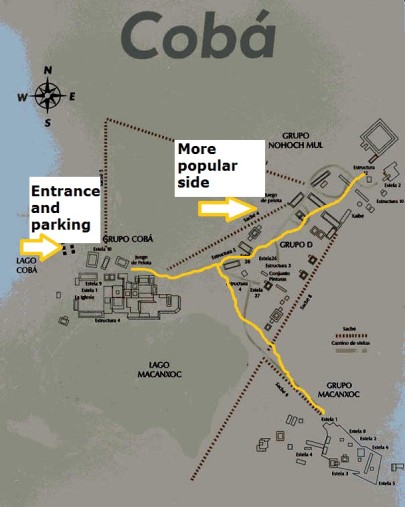
People are always wondering what it looks like on a map. This map we made show the entrance and the two sides you can visit. When you enter and take the trail if you go to the left you will get to the main pyramid. This is the more popular side. The yellow line are the two paths you can walk on or bike. Notice how it splits. Even though there is a lake there you will not see it because the trees are so thick.
Tip: Both inside the site by the main pyramid and by the entrance there are places to buy cold drinks. Check outside of the entrance for the “Mayan Red Bull” guy. He sells bee pollen energetic natural drink.
Tip: Bring your camera, water, cool clothes, comfortable walking shoes, sunscreen, your spirit of adventure, and bug spray at certain times of the year (especially if you walk the site instead of the bikes).
How to get to Coba ruins
Driving directions to Coba ruins
It is possible to rent a car and drive there. Roads are well marked, and it is only three road to take from Playa Del Carmen. Just watch out for speed bumps when you enter small, populated areas. See our article about driving in the Riviera Maya. There are lots of tips for driving around.
The road from Tulum and goes inland. It takes about 30 minutes from Tulum to the parking lot of Coba ruins. The route is well posted with signs. When you come to the traffic circle you will go to the left and take the road into Coba town. Pass through the small town and pass the lake on your right. You will see the parking lot ahead of you.
Public transportation and taxi to Coba ruins
This is very limited since Coba is not a main destination. There are colectivo vans that leave from Tulum going to Coba. these vans leave when filled up. Most of the passengers are people going to work or living in the small communities between Tulum and Coba.
In the Tulum Bus Station, you can ask for the current schedule to Coba, if one exists. ADO is the big bus company with first class buses. They did have service to Coba, but it is no longer listed on their website. Oriente is another second-class bus company that goes to smaller destinations and makes stops along the way. This might be an option.
Most people will rent a car or take a tour to see Coba ruins.
Recommended Coba Ruin Tours
Not everyone is going to want to drive themselves and try to figure out how to get to these ruins, speak some Spanish, and figure out where to go for lunch. So, a tour is a great idea! Here are several options with other activities included in the day. Click on the links below to read more about these tours.
Note: If you go online and try to look for a tour, be aware that some tours that say Coba might not actually go there since it was closed for climbing for a while. Also note, most tours add in a $35 tax to the tour price.
Tulum & Coba Ruins with Cenote Swim Tour from Playa Del Carmen
Normally we don’t recommend seeing two Mayan ruins in one day, but Coba and Tulum are so different yet are fairly close together to get between. This tour clicks off a lot of things for visitors, a cenote swim, and two famous ruins. Lunch is also included and pick up from Playa Del Carmen.

Coba Ruins, Punta Laguna Nature Reserve, Cenote and Mayan family
This tour takes you just to Coba ruins and adds on a more authentic look at the Mayan world. You get to explore more about the area of Coba and see nature up close, even by zip line! This is a small group tour. Lunch and activities are included. Depending on where you are in the Riviera Maya, there is an extra pickup fee.
Private Tour to See Coba Ruins
Going on a private tour will save your time since it is just your family. They will pick you up at an arranges time and give you a chance to form the itinerary to your wants. Private tours are more expensive, but worth it when you want your special day of exploration to be amazing! Usually, your tour day is something you will remember for a long time, why not make it the most special as possible. Absolute Adventures is a private tour company that we really recommend. They have top of the line guides and have been around for over a decade in the Riviera Maya. We have been on several tours with them and attest to their excellent quality and knowledge of the area. Plus, they always know those special spots that big tours cannot go to like small family run restaurants or cenotes that are spectacular. Check out their website here: https://absolute-adventure-mexico.com/
If you go here with a car, you might also want to check out the Coba cenotes nearby, they are really nice and newly opened for eco-tourism.
Have you been to Coba ruins? What did you think? What are your favorite ruins to visit? We would love to hear from you in the comment box below.
About The Author

Today, visitors can explore nearby cenotes, Choo Ha and Tamchaha that are a short 10 minute drive from the ruins main entrance. The cenotes are located to the west of Coba town. The cenotes are all different but I like the third one because you have to go down a carved staircase and the water is beautiful.
We did the “extreme” Coba Sunset excursion and loved it! We appreciated the cooler hours of the day and the shorter trip. Bicycling through the jungle was easy and a lot of fun (flat terrain with some scattered tree roots). The climb up the biggest temple was amazing but not easy, but worth the huffing and puffing up the steep, tall steps (I’m a slightly out-of-shape mom). I didn’t see many kids or grandparents do it, though. I was happy to use the rope on the way down, because many of the stones have become polished smooth and are dangerously slippery. They are likely going to stop letting people climb it soon. The zip line was fun and surprisingly relaxing (FYI – more steps to get to the top of the zipline). The cenote was great, with a neat spiral staircase down and a nice platform with stairs into the water, as well as a spot to jump/dive from. It is required to shower before going into the cenote, so we were able to remove the sunscreen and bug spray we had applied at the ruins. Bring your own towel. Life jackets are provided. The Mayan buffet dinner was delicious, and the show was fun (Mayan sports!). Our guide was of Mayan descent and explained the culture well. The excursion was well-organized, not too rushed. We were able to leave our stuff in the van between the mini-excursions (so we didn’t have to haul our towels/swimsuits around the ruins). We even watched Coco on the bus ride home! There is a “culture option” which includes a trip to a Mayan village, instead of the zip line and cenote – so families can do the first part together and then do activities most suited to each person. Bring lots of small bills (preferably pesos) to tip the various staff. Be sure to eat a hearty lunch before the excursion – you will work up an appetite! Water is provided at several points in the trip.